
How to choose blackout shades that really go dark
Almost every complaint about blackout shades is the same complaint: the fabric is opaque, but light still comes in around it. That is not a fabric problem. It is a geometry problem.
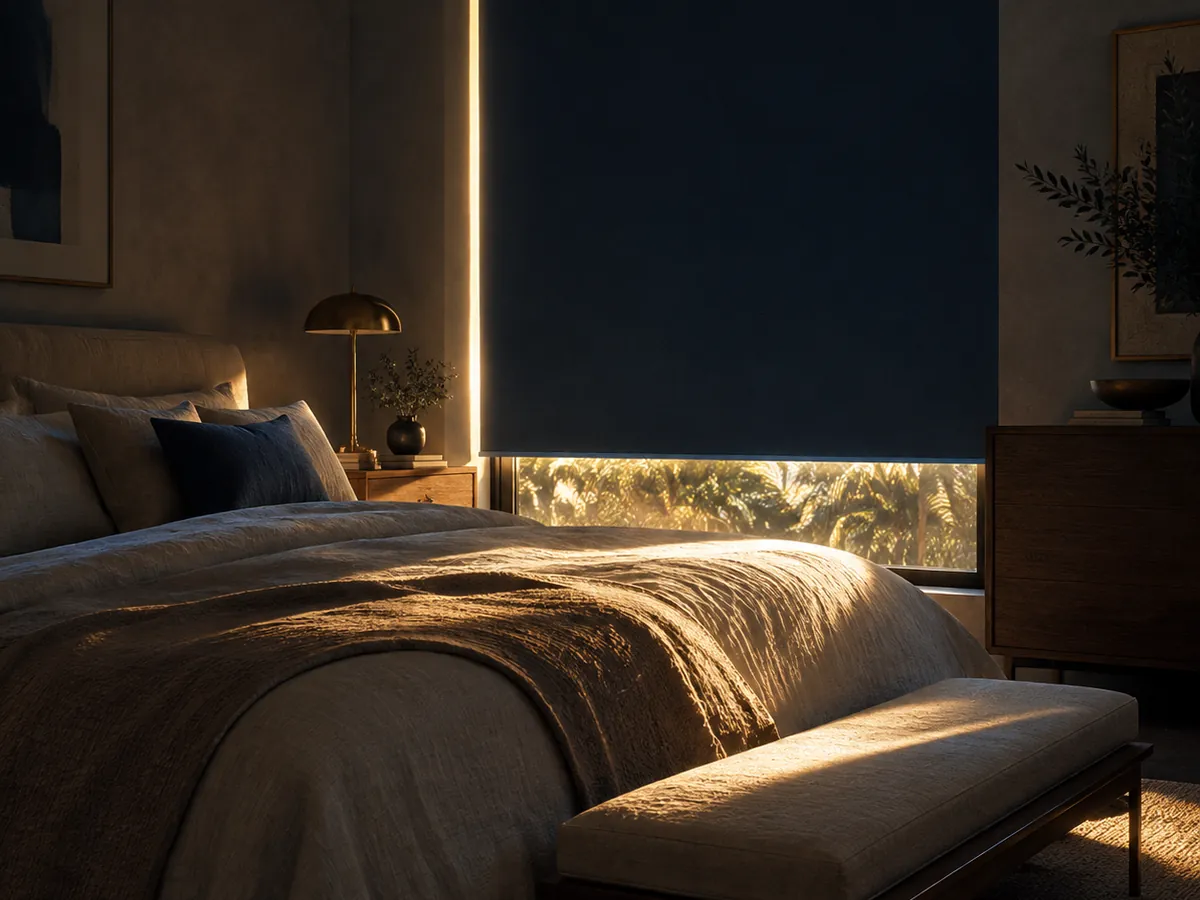
A blackout fabric blocks 100% of the light that passes through it. The problem is never what comes through: it is what comes around it, above it and below it.
1 · Inside mount or outside mount
An inside mount looks cleaner, but it necessarily leaves roughly a quarter-inch of clearance on each side so the shade does not rub. That clearance is, precisely, your light gap. An outside mount — the shade above the opening and overlapping on both sides — darkens far better. In a bedroom, the outside mount almost always wins.
2 · Side channels (the part almost nobody asks for)
These are U-shaped tracks fixed to the jambs: the fabric runs inside them and the gap disappears. It is the difference between a dark room and a genuinely dark room. If the goal is sleeping during the day, shift work or a media room, the channels are not an extra — they are the product.
With whatever shade you have now closed at midday, turn off the lights and wait a minute for your eyes to adjust. If you can see the window frame drawn in light, your problem is the edges, not the fabric. Changing fabric will not fix it.
3 · The headrail
There is always a gap above the roller tube. A closed cassette (or a pocket) covers that upper strip of light. Without one you will have a bright line on the ceiling even when the sides are solved.
4 · Fabric color: it matters less than you think
A white blackout fabric darkens exactly as well as a black one, because the blocking is done by the internal layer, not by the color. What does change is the edge glow: a light fabric bounces more light around the gap and makes it more visible. With side channels, it makes no difference.
5 · Two layers when you want both
Very common in bedrooms: a zebra or a screen for daytime and a blackout behind it for sleeping. Both can go on a single dual bracket and both can be motorized. It costs more, but it solves the whole room instead of half of it.
What to ask for in the quote
- Outside mount with at least two inches of overlap per side.
- Side channels if the room is for daytime sleeping.
- A closed cassette or a pocket at the headrail.
- Certified blackout fabric, not \u201croom darkening\u201d.
- And, if possible, a motor: a blackout you raise and lower by hand ends up parked halfway.
Shall we look at your windows?
Consultation, samples and measurement at no cost across Miami-Dade, Broward, Palm Beach, Naples and Fort Myers.
This content is provided for general guidance. Product availability, materials, colors, dimensions, controls, compatibility, installation requirements, maintenance, warranties and lead times vary by product and project. Final recommendations require verification, professional measurement and consultation.